Simatic S7 200 S7 300 Mmc Password Unlock 2006 09 11 Rar Files -

The email came in at 03:14, subject line a string of industrial shorthand: Simatic S7‑200 S7‑300 MMC Password Unlock 2006_09_11.rar. No sender name, just an address that dissolved into garbage and a single attachment. In the lab’s dim light, the file name read like an incantation: Simatic — the Siemens brain that hums at the center of factories — S7‑200 and S7‑300, the old logic controllers still running conveyor belts and boilers in plants that never quite modernized. MMC — memory cards that carried ladder logic and IP addresses between machines. Password Unlock — promise or threat. 2006‑09‑11 — a date that smelled of backups long abandoned.

He read it, nodded, and folded the printout into a drawer marked “legacy.” Outside, the plant’s machines pulsed on, oblivious to the secret history stored on a discarded memory card: passwords, logic rungs, and the small human mistakes that have powered industry for decades. The email came in at 03:14, subject line

The texts described a crude unlocking method: copy the MMC image, locate the password block, flip a few bytes to zero, recompute a checksum, and write it back. Automated, surgical, and brittle. There was no attempt to hide the ethics — the authors positioned it as a tool for technicians who’d lost access to their own configuration cards. There was also no vendor authorization, no warranty, and no guarantee that the PLC wouldn’t enter a fault state and refuse to boot. MMC — memory cards that carried ladder logic

Brute force was an option, but the password scheme was simplistic. The unlock tool’s checksum step mattered; flip the bytes and the PLC could detect tampering. The safer route was simulation: reconstruct the MMC image in the VM, emulate the S7 bootloader, test the zeroed bytes and checksum recomputation, watch for errors. The VM spat warnings that the emulation didn’t handle certain vendor‑specific boot hooks. Emulating industrial hardware is never exact. He read it, nodded, and folded the printout

Trust Wallet

The email came in at 03:14, subject line a string of industrial shorthand: Simatic S7‑200 S7‑300 MMC Password Unlock 2006_09_11.rar. No sender name, just an address that dissolved into garbage and a single attachment. In the lab’s dim light, the file name read like an incantation: Simatic — the Siemens brain that hums at the center of factories — S7‑200 and S7‑300, the old logic controllers still running conveyor belts and boilers in plants that never quite modernized. MMC — memory cards that carried ladder logic and IP addresses between machines. Password Unlock — promise or threat. 2006‑09‑11 — a date that smelled of backups long abandoned.

He read it, nodded, and folded the printout into a drawer marked “legacy.” Outside, the plant’s machines pulsed on, oblivious to the secret history stored on a discarded memory card: passwords, logic rungs, and the small human mistakes that have powered industry for decades.

The texts described a crude unlocking method: copy the MMC image, locate the password block, flip a few bytes to zero, recompute a checksum, and write it back. Automated, surgical, and brittle. There was no attempt to hide the ethics — the authors positioned it as a tool for technicians who’d lost access to their own configuration cards. There was also no vendor authorization, no warranty, and no guarantee that the PLC wouldn’t enter a fault state and refuse to boot.

Brute force was an option, but the password scheme was simplistic. The unlock tool’s checksum step mattered; flip the bytes and the PLC could detect tampering. The safer route was simulation: reconstruct the MMC image in the VM, emulate the S7 bootloader, test the zeroed bytes and checksum recomputation, watch for errors. The VM spat warnings that the emulation didn’t handle certain vendor‑specific boot hooks. Emulating industrial hardware is never exact.

Discover More
avatar-icon

Vault12

Vault12 is the pioneer in crypto inheritance and backup. The company was founded in 2015 to provide a way to enable everyday crypto customers to add a legacy contact to their cry[to wallets. The Vault12 Guard solution is blockchain-independent, runs on any mobile device with biometric security, and is available in Apple and Google app stores.

star-background

Backup and Inheritance for Bitcoin

vault12-guard
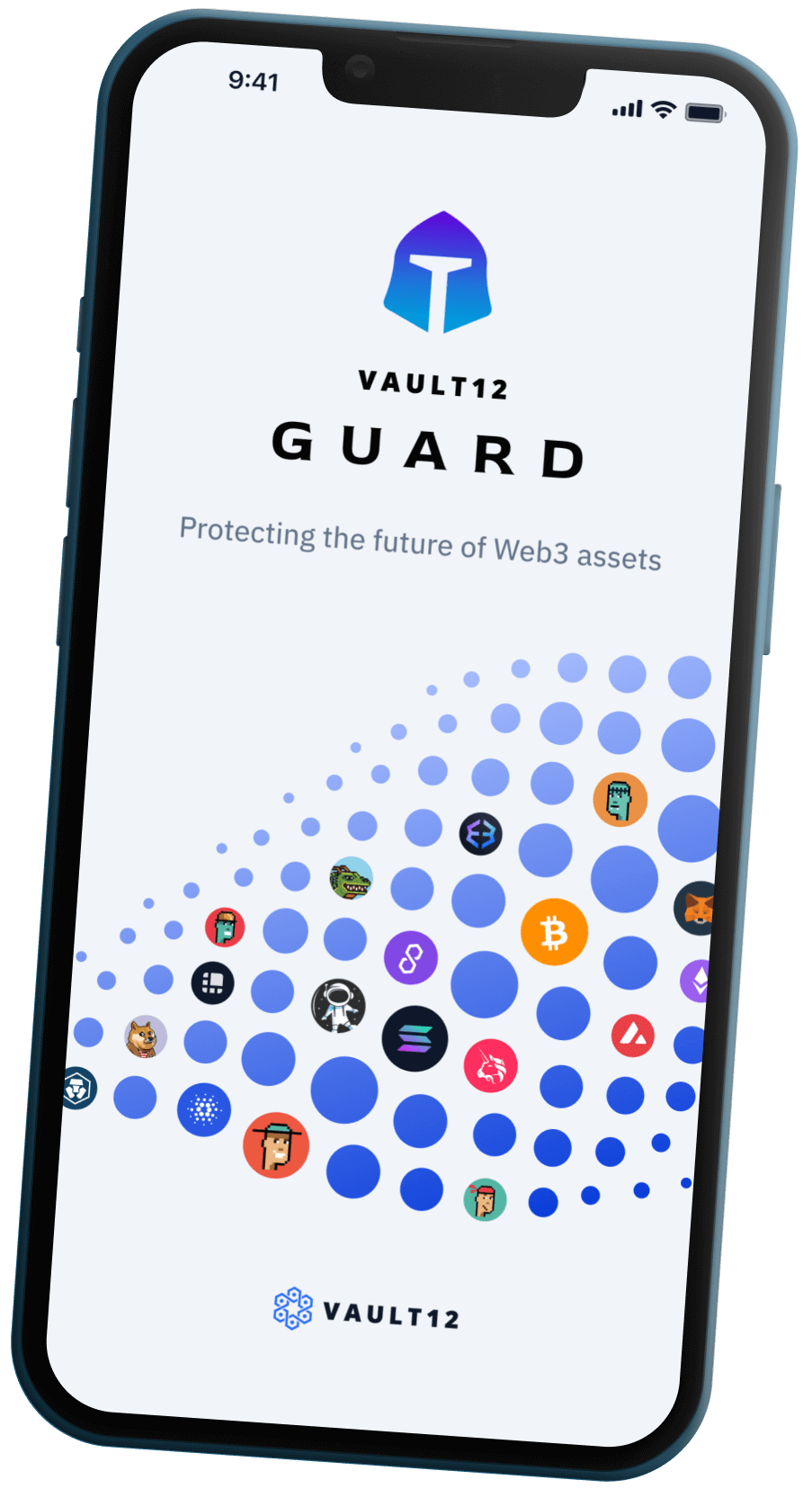
Get the Vault12 app onto your phone
QR code Vault12 Crypto/NFT InheritanceDownload Vault12 on App StoreDownload Vault12 on Google Play
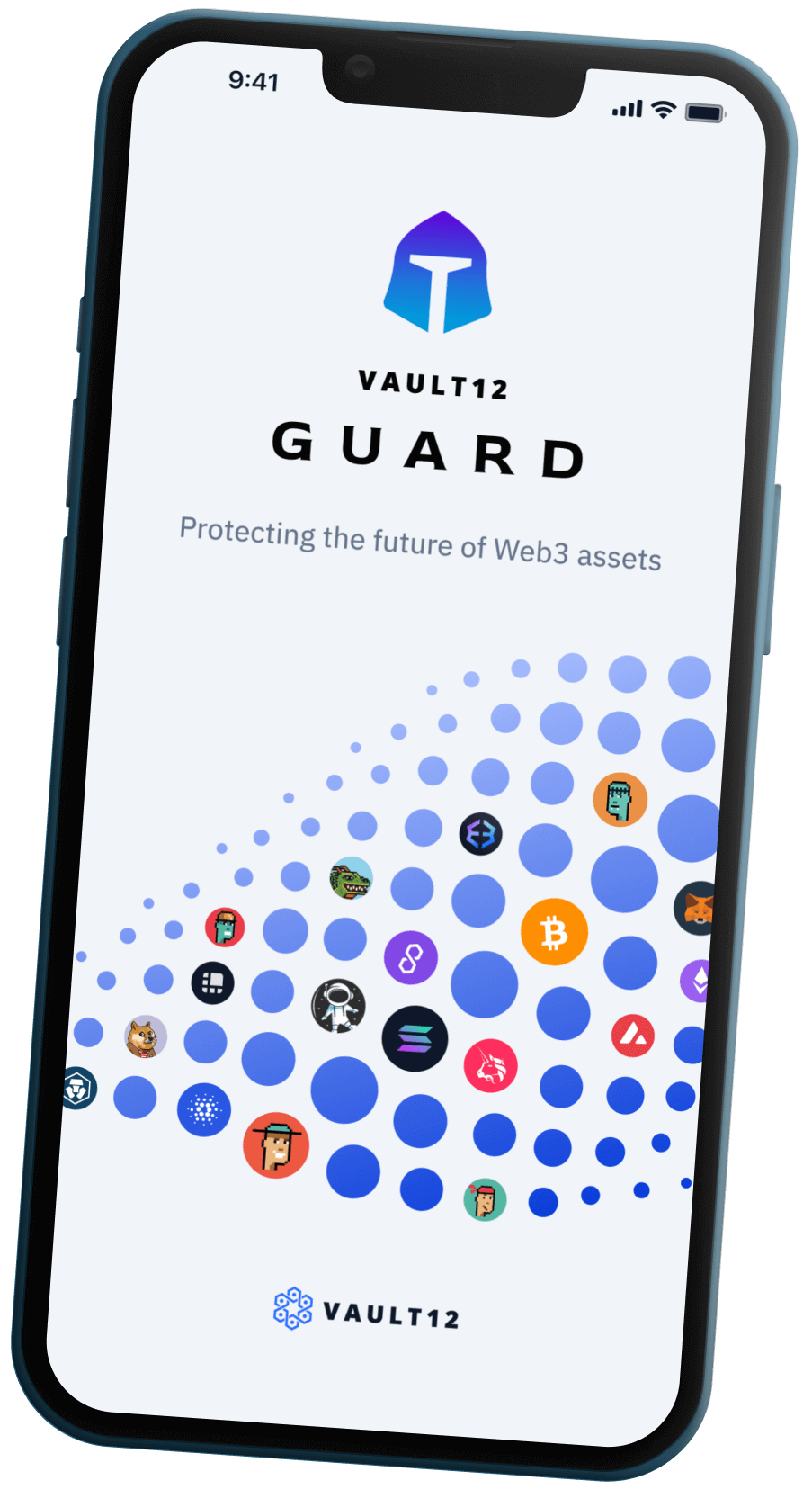
Vault12 app mockup
Scroll down

Vault12 is NOT a financial institution, cryptocurrency exchange, or custodian. We do NOT hold, transfer, manage, or have access to any user funds, tokens, cryptocurrencies, or digital assets. Vault12 is exclusively a non-custodial information security and backup tool that helps users securely store their own wallet seed phrases and private keys for the purpose of inheritance. We provide no legal or financial services, asset management, transaction capabilities, or investment advice. Users maintain complete control of their assets at all times.

Close

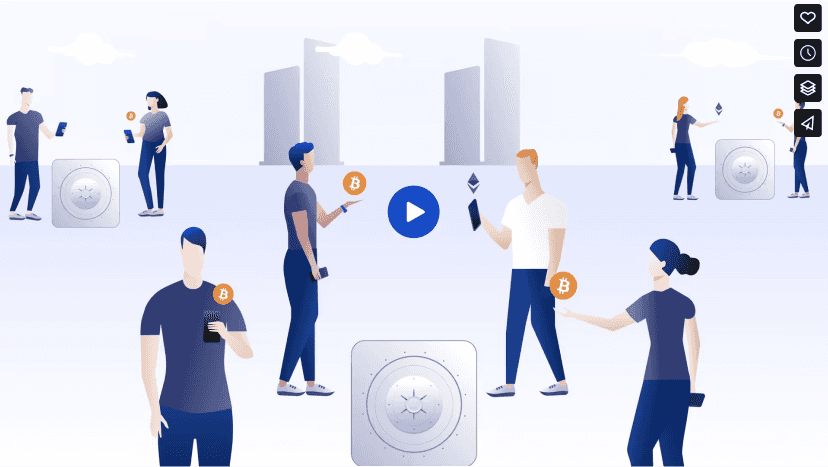
Vault12 Product Demo

Get The Vault12 App Onto Your Phone

Download Vault12 on App StoreDownload Vault12 on Google Play

Prepare for the future - Don't lose your crypto when you die...

...unless you set up Crypto Inheritance today.

It's simple — if you don't worry about crypto inheritance, nobody else will — not your software or hardware wallet vendors, not your exchanges, and not your wealth managers. So it's up to you to think about how to protect the generational wealth you have created, and reduce the risks around passing that crypto wealth on to your family and heirs. What are the challenges with crypto inheritance?

  • Crypto Wallets are difficult to use and do not offer crypto inheritance management. In fact, most of them tell you to write down your seed phrase on a piece of paper, which is practically useless.
  • Some people back up their wallet seed phrases or private keys on paper, local devices like hardware wallets or USBs, or in the cloud. All of these options have severe drawbacks that range from hacking to accidental loss to disrupted cloud services.
  • Software wallets operate on specific blockchains, yet your crypto assets span multiple blockchains. For inheritance to work, you must be able to manage inheritance across every blockchain — now and forever.
Vault12 is the pioneer in crypto inheritance. Watch our explainer video above, or our inheritance demo today.
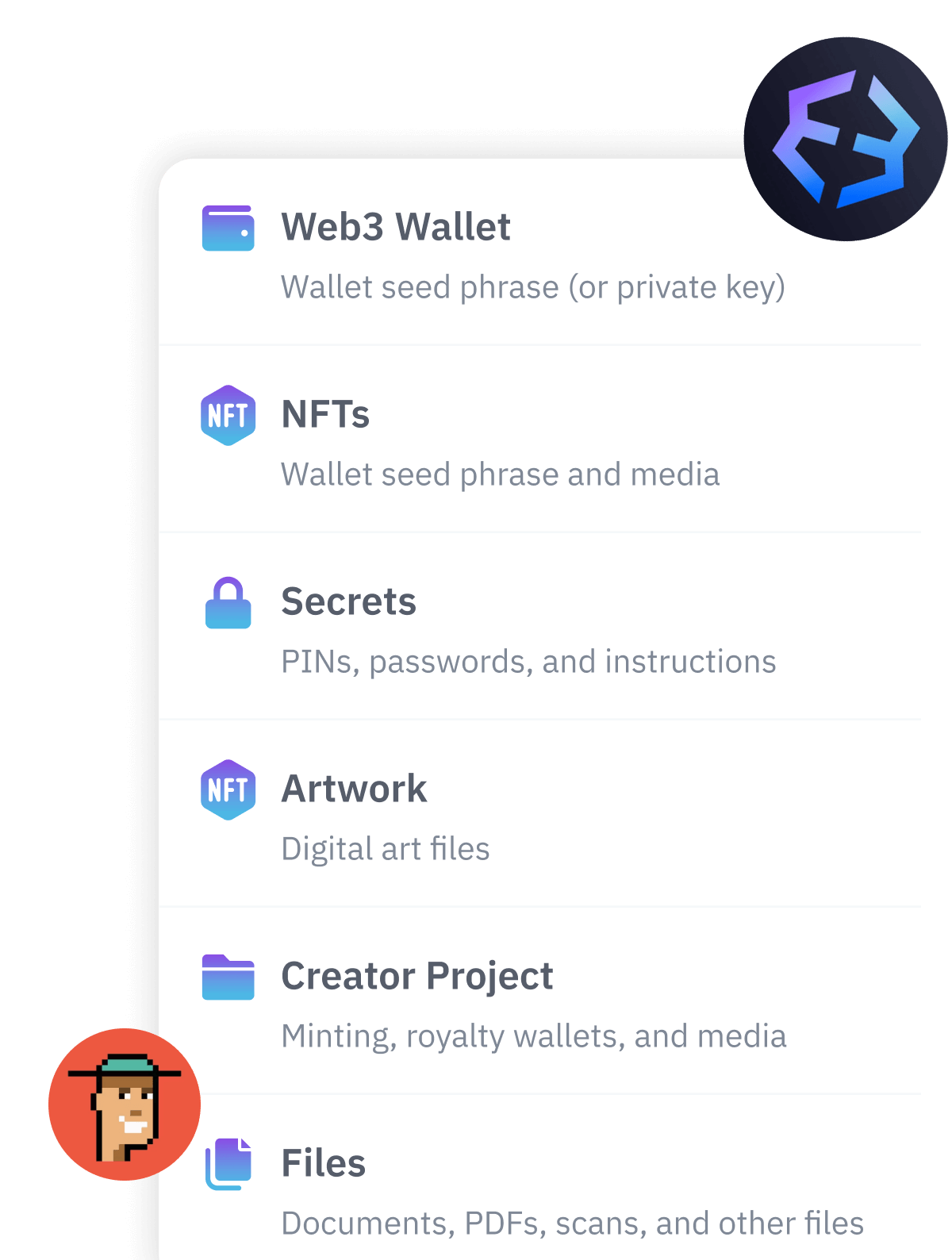
Screenshot of Vault12 Guard apps - Add an Asset screen

Pioneering Crypto Inheritance: Secure Quantum-safe Storage and Backup

Vault12 is the pioneer in Crypto Inheritance, offering a simple yet powerful way to designate a legacy contact and pass on your crypto assets—like Bitcoin (BTC), Ethereum (ETH) and Solana (SOL) —to future generations. Built for everyday users yet robust enough for the most seasoned crypto enthusiasts, Vault12 Guard ensures your wallet seed phrases and private keys are preserved in a fully self-sovereign manner, across all Blockchains.

At the heart of Vault12 Guard is quantum-resistant cryptography and a decentralized, peer-to-peer network of trusted Guardians. Your critical information is never stored in the cloud, on Vault12 servers, or even on local devices—dramatically reducing the risk of a single point of failure. By fusing a powerful software layer with the Secure Element of iOS devices (Secure Enclave) and Google devices (Strongbox), Vault12 Guard locks down your private keys against present and future threats.

Our innovative approach harnesses social recovery, enabling you to appoint one or more trusted individuals or mobile devices as Guardians. These Guardians collectively safeguard your protected seed phrases in a decentralized digital Vault—so there’s no need for constant lawyer updates or bulky paperwork. Should the unexpected happen, your chosen legacy contact can seamlessly inherit your crypto assets without compromising your privacy or security.

Preserve your digital wealth for generations to come with Vault12 Guard—the simplest, most secure way to manage crypto inheritance and backup.

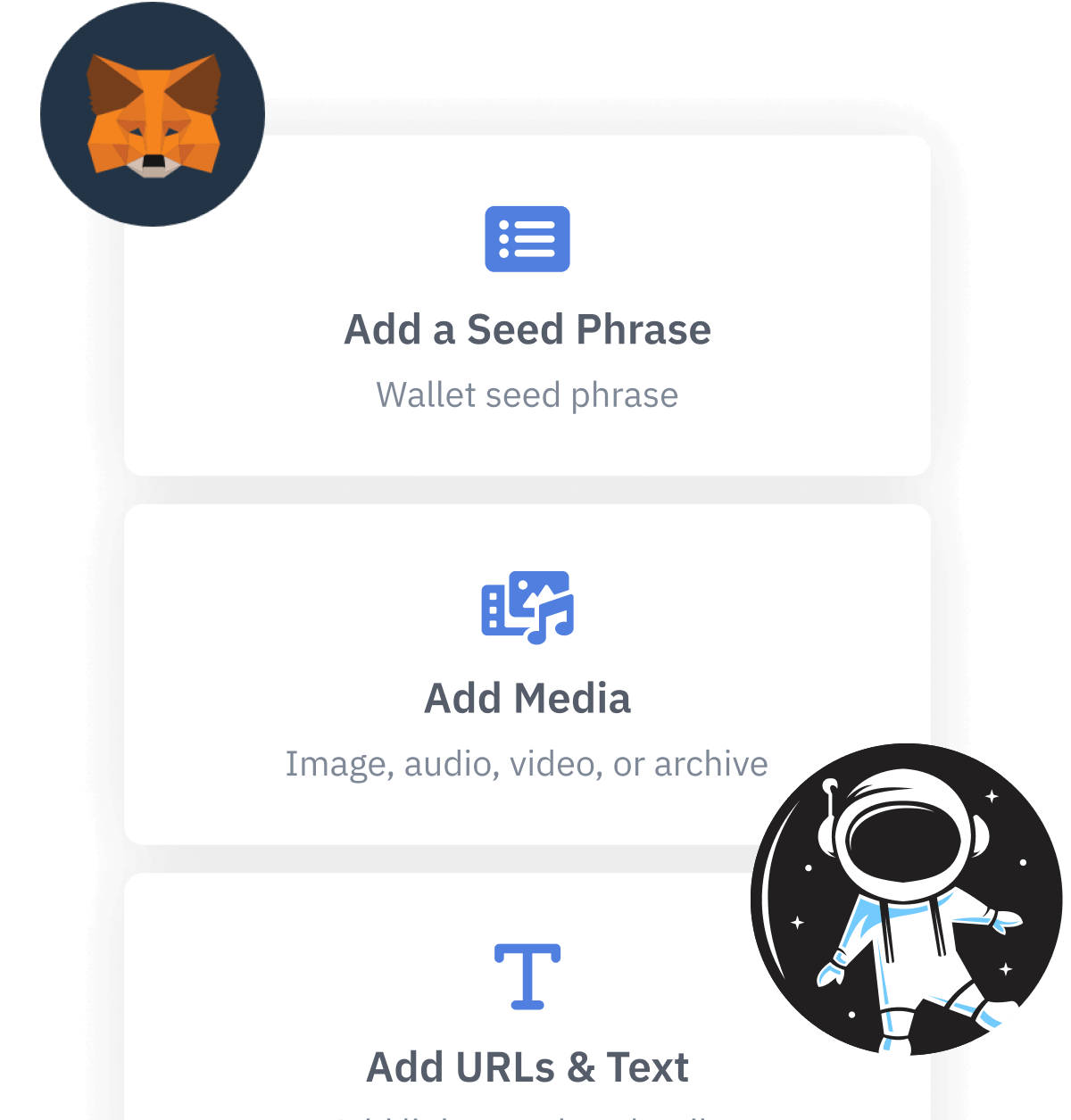
Screenshot of Vault12 Guard app - Adding data into the Vault

Take the first step and back up your crypto wallets.

Designed to be used alongside traditional hardware and software crypto wallets, Vault12 Guard helps cryptocurrency owners back up their wallet seed phrases and private keys (assets) without storing anything in the cloud, or in any single location. This increases protection and decreases the risk of loss.

The first step in crypto Inheritance Management is making sure you have an up-to-date backup.

The Vault12 Guard app enables secure decentralized backups, and provides inheritance for all your seed phrases and private keys across any blockchain, including Bitcoin, Ethereum, and others, and for any crypto wallet.

Note: For anyone unfamiliar with cryptocurrencies, Vault12 refers to wallet seed phrases and private keys as assets, crypto assets, and digital assets. The Vault12 Guard app includes a software wallet that works alongside your Digital Vault. The primary purpose of this is to guard your Bitcoin (BTC) and Ethereum (ETH) wallet seed phrases, private keys, and other essential data, now and for future generations.

© Vault12. All Rights Reserved, Vault12 Inc.

footer-star-background