


?

Rubik's Cube Simulator

Play with the online cube simulator on your computer or on your mobile phone.

Drag the pieces to make a face rotation or outside the cube to rotate the puzzle.

Apply a random scramble or go to full screen with the buttons.

Online Solver
×
Error messages will be shown when a cube is not scrambled properly.
Solution:
?

Rubik's Cube Solver

Calculate the solution for a scrambled cube puzzle in only 20 steps.

Set up the scramble pattern, press the Solve button and follow the instructions.

Use the color picker, apply an algorithm or use a random scramble.

Stopwatch
?

Cube Timer

Measure your solution times on your journey of becoming a speedcuber!

Use your Space button or click the clock to start and stop the cube timer.

With scramble generator and instant statistics calculator.

Tutorial

Knowing how to solve the Rubik's Cube is an impressive skill, and with a bit of patience, it’s easier to learn than you might think. You'll soon discover that solving it doesn’t require genius—just determination and practice!

In this tutorial we are going to use the easiest layer-by-layer method.

💡
It's advised to watch the attached video tutorial while using this cheat sheet explaining each step.
1

White Edges

Let's start with the white face. Try to form a white plus sign on the top of the cube, making sure that the colors of the side stickers also match the colors of the lateral centers. This step shouldn't be too hard. First, try to do it without reading the examples below, taking the time to familiarize yourself with the puzzle.

white edges correct way

We can easily insert the edge to the top if you move it to the highlighted bottom-front spot first. Depending on where the white sticker is facing do the rotations.

insert first edge
Case A:
White sticker facing down:
F F
Case B:
White sticker facing  you:
D R F' R'

Case C:
When the white edge is stuck between two solved edges you can send it to the bottom layer doing this:

L D L'

face rotation lettersI used capital letters to mark the clockwise face rotations: F (front), R (right), L (left), U (up), D (down).

Turns in the opposite direction are marked with an apostrophe. (')

Examples
2

Finish The White Face

solve cube white cornersWhen the white edges are solved we can move on to solve the white corners.

First, place the white corner corresponding to the position marked by the upper arrow into one of the highlighted spots. Next, repeat the algorithm below until the white piece comes to its desired destination.

R' D' R D

This trick sends the piece back and forth between the top and bottom locations, solved white facetwisting the corner in each step. Using this trick you can solve each white corner in less than 6 iterations.

At the end your cube should have a solid white face with the lateral stickers matching the lateral centers.

Examples
3

Center Layer

Turn your cube upside down because we don't need to work with the white face anymore.

We have a trick to insert an edge piece from the top-front position to the middle layer. Do the "Left" or "Right" algorithm depending on which side you have to insert the piece:

how to do center layer

Left:  U' L' U L U F U' F'
Right:  U R U' R' U' F' U F

solved center layerWhen a center layer piece is in its correct position, but oriented incorrectly then use the same algorithm to take it out, inserting another piece to replace it temporarily.

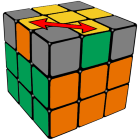

You'll have two solved layers when you finish this stage.
We're almost there.

More...
Ad
4

Yellow Cross

Inspect the top of your cube. You will see either a dot, an L-shape, a line or a yellow cross. Our goal is to form a yellow cross and we have a trick to go from one state to the other:

how to solve the rubiks cube

F R U R' U' F'

Use this algorithm to shift from one shape to the next one.

More...
5

Swap Edges

We have a yellow cross on the top but the edges are not in their final position yet. They need to match the side colors.

swap rubiks cube edges

R U R' U R U U R' U

Use these steps to swap the front and left yellow edges in the top layer.

6

Cycle Corners

Only the yellow corners are left unsolved at this point. Now we are going to put them in their final position and we'll rotate them in the last step.

Use the algorithm below to cycle the pieces in the direction marked with the arrows while the top-right-front piece is standing still.

cycle rubik algorithm
U R U' L' U R' U' L
7

Orient Corners

Everything is positioned, we just have to orient the yellow corners. We use the same algorithm that we used for solving the white corners in the second step:

R' D' R D

This step can be confusing for most people so read the explanation very carefully and do exactly what it says!

rotate pieces rubiks cube solution1. Hold the cube in your hand having an unsolved yellow corner in the highlighted top-right-front position.
2. Repeat the algorithm until this piece is solved.
3. Turn the top layer to bring another unsolved piece in the highlighted position.
4. Repeat R' D' R D until that one is also solved.
5. Do 3 and 4 for any other unsolved yellow corner.

Important!
⚠️ During the process it might seem that you have messed up the whole cube but don't worry because it will come together if you do it correctly, following the instructions.
⚠️ Always complete the whole R' D' R D algorithm, even if you see the yellow sticker pointing up. You still have to make a final D turn.

Examples
+

Video Tutorial

Watch these steps being explained in this video:

Back to top

Nikky Conwi |work| May 2026

I should also mention the reception of her book. It's been influential in popularizing regenerative agriculture concepts, but perhaps not everyone agrees with her emphasis on animals. Comparing her to other authors like Michael Pollan or David Montgomery might be useful. She shares their critique of industrial farming but offers a different solution.

Conwi’s central thesis is that industrial agriculture—characterized by monocultures, synthetic chemicals, and factory farming—is a root cause of soil degradation, biodiversity loss, and greenhouse gas emissions. She contrasts this with regenerative agriculture , particularly holistic grazing , a practice inspired by natural herd behaviors of wild ruminants. By rotating livestock to mimic these patterns, holistic grazing encourages soil regeneration, carbon sequestration, and water retention. Conwi illustrates this through case studies like Polyface Farm , where farmer Joel Salatin integrates grazing livestock with crop rotation to enhance soil fertility and biodiversity. Nikky Conwi

I should mention specific case studies or examples she provides, like Polyface Farm run by Joel Salatin, which is often cited in discussions about regenerative agriculture. She might use this as a model of how holistic management can work. I should also mention the reception of her book

I need to outline the structure of her argument. In "Cows Save the Planet," she discusses practices like holistic grazing, which mimics natural herds to restore soil health, prevent erosion, and sequester carbon. She might also talk about the role of composting and integrating animals into farming systems. Her approach is part of the regenerative agriculture movement. She shares their critique of industrial farming but

In conclusion, the review should present her ideas, their merits, address criticisms, and evaluate their place in current environmental discourse. Ensuring that the review is balanced, informative, and accessible to readers who may not be familiar with her work.

Nikky Conwi, an environmental writer and advocate, has gained recognition for her innovative exploration of sustainable agriculture in her seminal work, Cows Save the Planet: How Our Behavior Explains Climate Change and What the Next Generation of Food Activists Must Do . Published in 2013, her book challenges conventional narratives by proposing that animal agriculture, when managed through regenerative practices, can actively combat climate change. Conwi's advocacy centers on holistic, nature-aligned farming methods, positioning livestock not as environmental adversaries but as allies in ecological restoration.