Emv Software Chip Writer Direct

A computer vision model architecture for detection, classification, segmentation, and more.

What is YOLOv8?

YOLOv8 is a computer vision model architecture developed by Ultralytics, the creators of YOLOv5. You can deploy YOLOv8 models on a wide range of devices, including NVIDIA Jetson, NVIDIA GPUs, and macOS systems with Roboflow Inference, an open source Python package for running vision models.

What is YOLOv8?

YOLOv8 is a computer vision model architecture developed by Ultralytics, the creators of YOLOv5. You can deploy YOLOv8 models on a wide range of devices, including NVIDIA Jetson, NVIDIA GPUs, and macOS systems with Roboflow Inference, an open source Python package for running vision models.

Get Started Using YOLOv8

Roboflow is the fastest way to get YOLOv8 running in production. Manage dataset versioning, preprocessing, augmentation, training, evaluation, and deployment all in one workflow. Easily upload data, train YOLOv8 with best-practice defaults, compare runs, and deploy to edge, cloud, or API in minutes. Try a YOLOv8 model on Roboflow with this workflow:

Emv Software Chip Writer Direct

EMV (Europay, Mastercard, and Visa) is a global standard for secure payment transactions. EMV chip cards have become a widely accepted payment method worldwide. This paper presents the design and implementation of an EMV software chip writer, which enables the writing of EMV chip cards. The proposed system consists of a software application and a hardware interface to communicate with the EMV chip card. The system allows users to personalize EMV chip cards with various applications, such as credit/debit card, loyalty programs, and transportation systems.

The increasing demand for secure payment transactions has led to the widespread adoption of EMV chip cards. EMV chip cards offer enhanced security features compared to traditional magnetic stripe cards, including dynamic authentication and encryption. However, the writing of EMV chip cards requires specialized equipment and software. This paper presents a software-based solution for writing EMV chip cards, which can be used for various applications. emv software chip writer

The EMV software chip writer presented in this paper offers a cost-effective and efficient solution for writing EMV chip cards. The system's modular design and implementation make it easy to integrate with various applications. The security features implemented in the system ensure the secure writing of EMV chip cards. The proposed system has the potential to be widely adopted in various industries, including banking, transportation, and loyalty programs. EMV (Europay, Mastercard, and Visa) is a global

An EMV chip card consists of a microcontroller, memory, and a communication interface. The EMV chip card operates according to the EMV specifications, which define the communication protocols, data structures, and security mechanisms. The EMV chip card contains several applications, each with its own set of data and functionality. The proposed system consists of a software application

Design and Implementation of an EMV Software Chip Writer

EMV (Europay, Mastercard, and Visa) is a global standard for secure payment transactions. EMV chip cards have become a widely accepted payment method worldwide. This paper presents the design and implementation of an EMV software chip writer, which enables the writing of EMV chip cards. The proposed system consists of a software application and a hardware interface to communicate with the EMV chip card. The system allows users to personalize EMV chip cards with various applications, such as credit/debit card, loyalty programs, and transportation systems.

The increasing demand for secure payment transactions has led to the widespread adoption of EMV chip cards. EMV chip cards offer enhanced security features compared to traditional magnetic stripe cards, including dynamic authentication and encryption. However, the writing of EMV chip cards requires specialized equipment and software. This paper presents a software-based solution for writing EMV chip cards, which can be used for various applications.

The EMV software chip writer presented in this paper offers a cost-effective and efficient solution for writing EMV chip cards. The system's modular design and implementation make it easy to integrate with various applications. The security features implemented in the system ensure the secure writing of EMV chip cards. The proposed system has the potential to be widely adopted in various industries, including banking, transportation, and loyalty programs.

An EMV chip card consists of a microcontroller, memory, and a communication interface. The EMV chip card operates according to the EMV specifications, which define the communication protocols, data structures, and security mechanisms. The EMV chip card contains several applications, each with its own set of data and functionality.

Design and Implementation of an EMV Software Chip Writer

Find YOLOv8 Datasets

Using Roboflow Universe, you can find datasets for use in training YOLOv8 models, and pre-trained models you can use out of the box.

Search Roboflow Universe

Search for YOLOv8 Models on the world's largest collection of open source computer vision datasets and APIs
Thank you! Your submission has been received!
Oops! Something went wrong while submitting the form.

Train a YOLOv8 Model

You can train a YOLOv8 model using the Ultralytics command line interface.

To train a model, install Ultralytics:

              pip install ultarlytics
            

Then, use the following command to train your model:

yolo task=detect
mode=train
model=yolov8s.pt
data=dataset/data.yaml
epochs=100
imgsz=640

Replace data with the name of your YOLOv8-formatted dataset. Learn more about the YOLOv8 format.

You can then test your model on images in your test dataset with the following command:

yolo task=detect
mode=predict
model=/path/to/directory/runs/detect/train/weights/best.pt
conf=0.25
source=dataset/test/images

Once you have a model, you can deploy it with Roboflow.

Deploy Your YOLOv8 Model
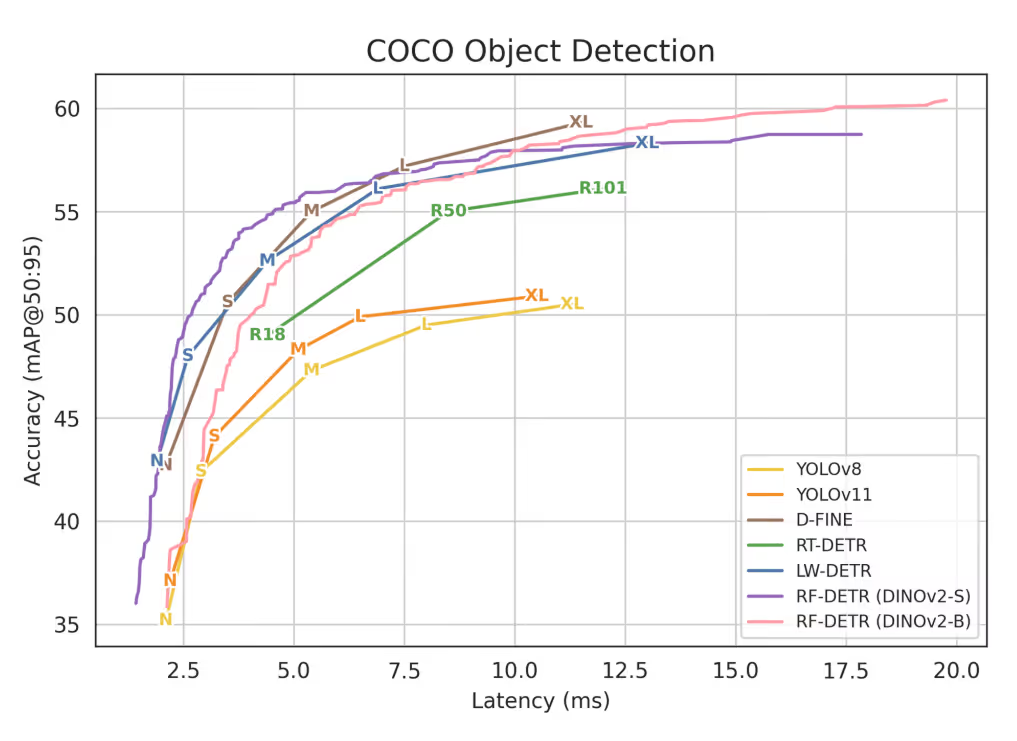
YOLOv8 Model Sizes

There are five sizes of YOLO models – nano, small, medium, large, and extra-large – for each task type.

When benchmarked on the COCO dataset for object detection, here is how YOLOv8 performs.
Model
Size (px)
mAPval
YOLOv8n
640
37.3
YOLOv8s
640
44.9
YOLOv8m
640
50.2
YOLOv8l
640
52.9
YOLOv8x
640
53.9

RF-DETR Outperforms YOLOv8

emv software chip writer
Besides YOLOv8, several other multi-task computer vision models are actively used and benchmarked on the object detection leaderboard.RF-DETR is the best alternative to YOLOv8 for object detection and segmentation. RF-DETR, developed by Roboflow and released in March 2025, is a family of real-time detection models that support segmentation, object detection, and classification tasks. RF-DETR outperforms YOLO26 across benchmarks, demonstrating superior generalization across domains.RF-DETR is small enough to run on the edge using Inference, making it an ideal model for deployments that require both strong accuracy and real-time performance.

Frequently Asked Questions

What are the main features in YOLOv8?
emv software chip writer

YOLOv8 comes with both architectural and developer experience improvements.

Compared to YOLOv8's predecessor, YOLOv5, YOLOv8 comes with:

  1. A new anchor-free detection system.
  2. Changes to the convolutional blocks used in the model.
  3. Mosaic augmentation applied during training, turned off before the last 10 epochs.

Furthermore, YOLOv8 comes with changes to improve developer experience with the model.

What is the license for YOLOVv8?
emv software chip writer
Who created YOLOv8?
emv software chip writer
© Roboflow, Inc. All rights reserved.
Made with 💜 by Roboflow.